 On
an unsolved question about the Smarandache Square-Partial-Digital Subsequence
On
an unsolved question about the Smarandache Square-Partial-Digital Subsequence
Felice
Russo
Micron Technology Italy
Avezzano (Aq) – Italy
Abstract
In this note we report the solution
of an unsolved question on Smarandache Square-Partial-Digital Subsequence. We
have found it by extesive computer search.
Some new questions about
palindromic numbers and prime numbers in SSPDS are posed too.
Introduction
The Smarandache Square-Partial-Digital
Subsequence (SSPDS) is the sequence of square integers which admits a partition
for which each segment is a square integer [1],[2],[3].
The first terms of the sequence
follow:
49, 144, 169, 361, 441, 1225,
1369, 1444, 1681, 1936, 3249, 4225, 4900, 11449, 12544, 14641, 15625, 16900 …
or
7, 12, 13, 19, 21, 35, 37, 38, 41,
44, 57, 65, 70, 107, 112, 121, 125, 130, 190, 191, 204, 205, 209, 212, 223, 253
…
reporting the value of n^2 that
can be partitioned into two or more numbers that are also squares (A048653)
[5].
Differently from the sequences
reported in [1], [2] and [3] the proposed ones don’t contain terms that admit 0
as partition. In fact as reported in [4] we don’t consider the number zero a
perfect square.
So, for example, the term 256036
and the term 506 respectively, are not reported in the above sequences because
the partion 256/0/36 contains the number zero.
L. Widmer explored some properties
of SSPDS’s and posed the following question [2]:
Is there a sequence of three or
more consecutive integers whose squares are in SPDS?
This note gives an answer to this
question.
Results
A computer code has been written
in Ubasic Rev. 9.
After about three week of work
only a solution for three consecutive integers has been found. Those consecutive
integers are: 12225, 12226,12227.
|
n |
n^2 |
Partition |
|
12225 |
149450625 |
1, 4, 9, 4, 50625 |
|
12226 |
149475076 |
1, 4, 9, 4, 75076 |
|
12227 |
149499529 |
1, 4, 9, 4, 9, 9, 529 |
No other three consecutive integers
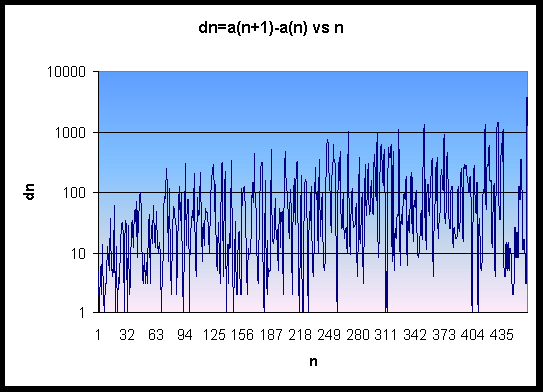
or more have been found for terms in SSPDS up to about 3.3E+9. Below a graph of
distance dn between the terms of sequence A048653 versus n is given; in
particular dn=a(n+1)-a(n) where n is the n-th term of the sequence.
According to the previous results
we are enough confident to offer the following conjecture:
 There are no four consecutive integers whose squares are in SSPDS.
New Questions
Starting with the sequence
(A048646), reported above, the following sequence can be created [5] (A048653):
7, 13, 19, 37, 41, 107, 191, 223,
379, 487, 1093, 1201, 1301, 1907, 3019, 3371, 5081, 9041, 9721, 9907……
that we can call "
Smarandache Prime-Square-Partial-Digital-Subsequence " because all the
squares of these primes can be partitioned into two or more numbers that are
also squares.
By looking this sequence the
following questions can be posed:
- Are there other palindromic primes in this
sequence beyond the palprime 191?
- Is there at least one plandromic prime in this
sequence which square is a palindromic square?
- Are there in this sequence other two or more
consecutive primes beyond 37 and 41?
If we look now at the terms of the
sequence A048653 we discover that two of them are very interesting:
121 and 212
Both numbers are palindromes and
their squares are in SSPDS and palindromes too. In fact 121^2=14641 can be
partitioned as: 1,4,64,4 and 212^2=44944 can be partitioned in five squares
that are also palindromes: 4, 4, 9, 4, 4. These are the only terms found by our
computer search. So the following question arises:
1.
How
many other SSPDS palindromes do exist ?
References
[1] Sylvester Smith, "A Set
of Conjectures on Smarandache Sequences", Bulletin of Pure and
Applied Sciences, (Bombay, India), Vol. 15 E (No. 1), 1996, pp. 101-107.
[2] L.Widmer, Construction of
Elements of the Smarandache Square-Partial-Digital Sequence, Smarandache
Notions Journal, Vol. 8, No. 1-2-3, 1997, 145-146.
[3] C. Dumitrescu and V. Seleacu,
Some notions and questions in Number Theory, Erhus University Press, Glendale,
Arizona, 1994
[4] E. W. Weisstein, CRC Concise
Encyclopedia of Mathematics, CRC Press 1999, p. 1708
[5} N. Sloane, On-line
Encyclopedia of Integer Sequences, http://www.research.att.com/~njas/sequences